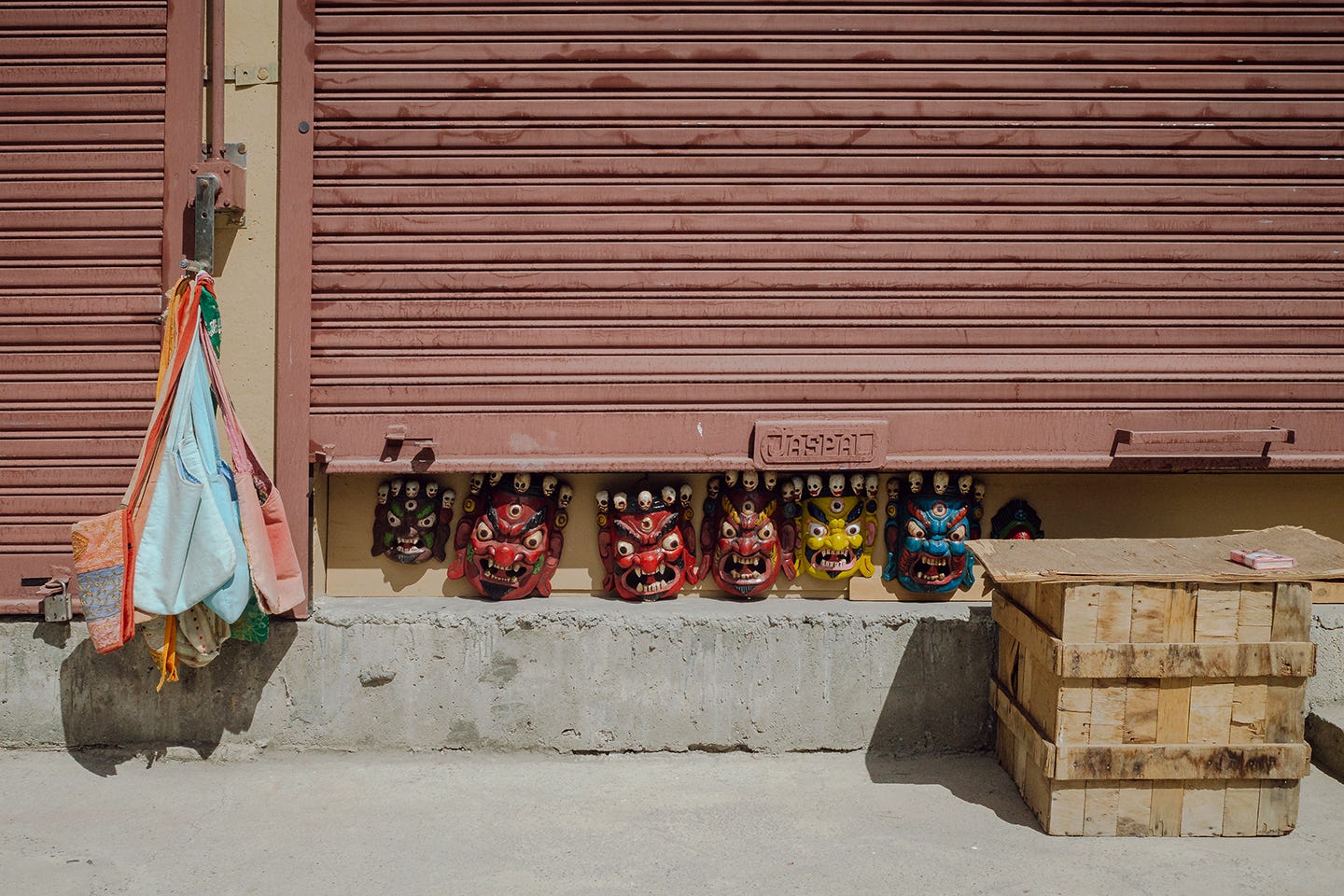

At more than 3,600 metres, the mountains leave very little room for anything except jagged rocks and immense blue skies, entirely indifferent to human presence, including mine. Welcome to Tabo, a tiny town resting in the long valley of Spiti, in Himachal Pradesh (India).
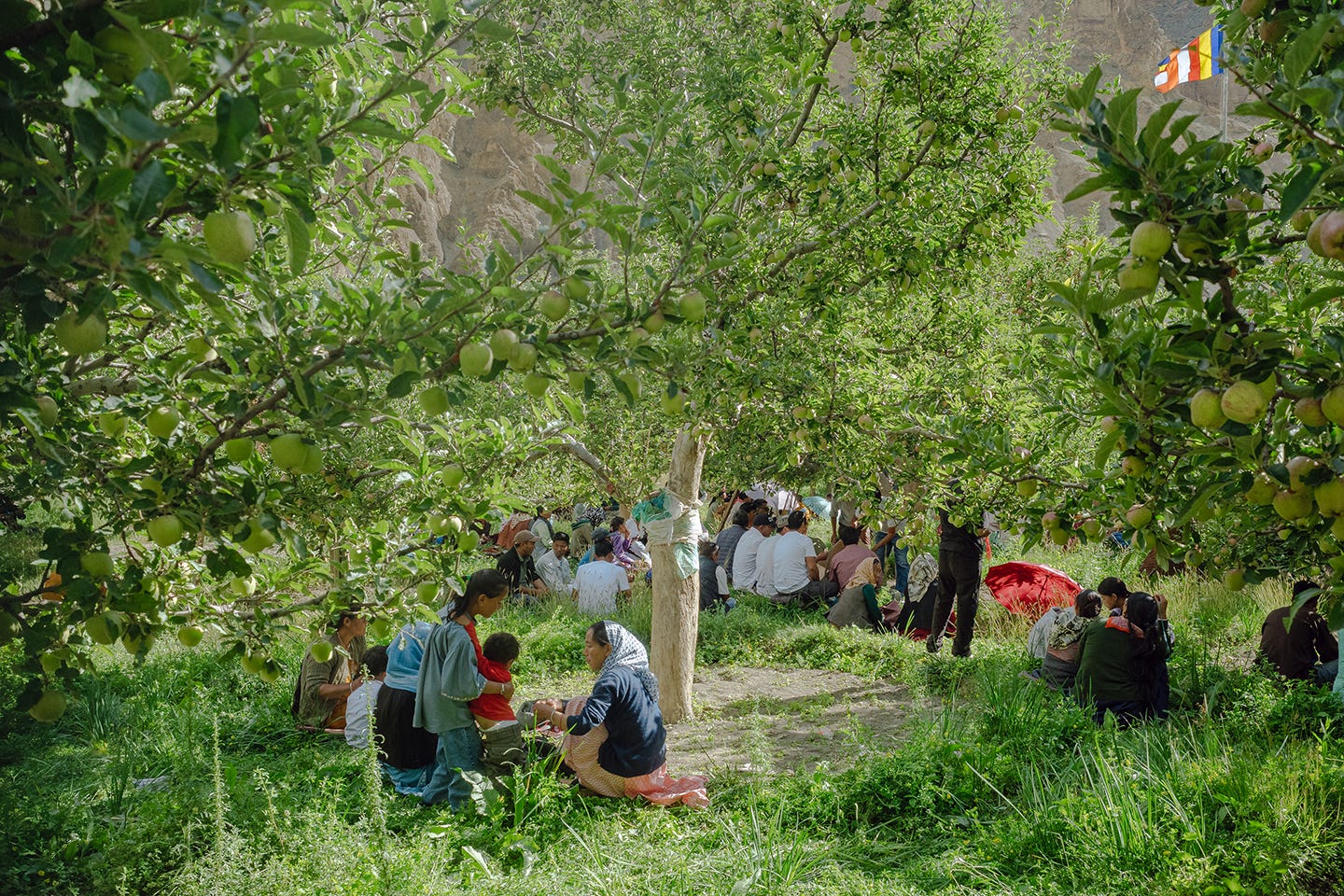
Strolling here and there, tiny pockets of life manage to take hold, with mud houses, fields, trees, and a few improbable yet abundant apple orchards.
You know, at this altitude, a tree is never just a tree.
It is shade. It is food.
It is a splash of defiant chlorophyll.
It is shelter for the being.
And more importantly, a reason enough for people to gather around the same vital epicenter.
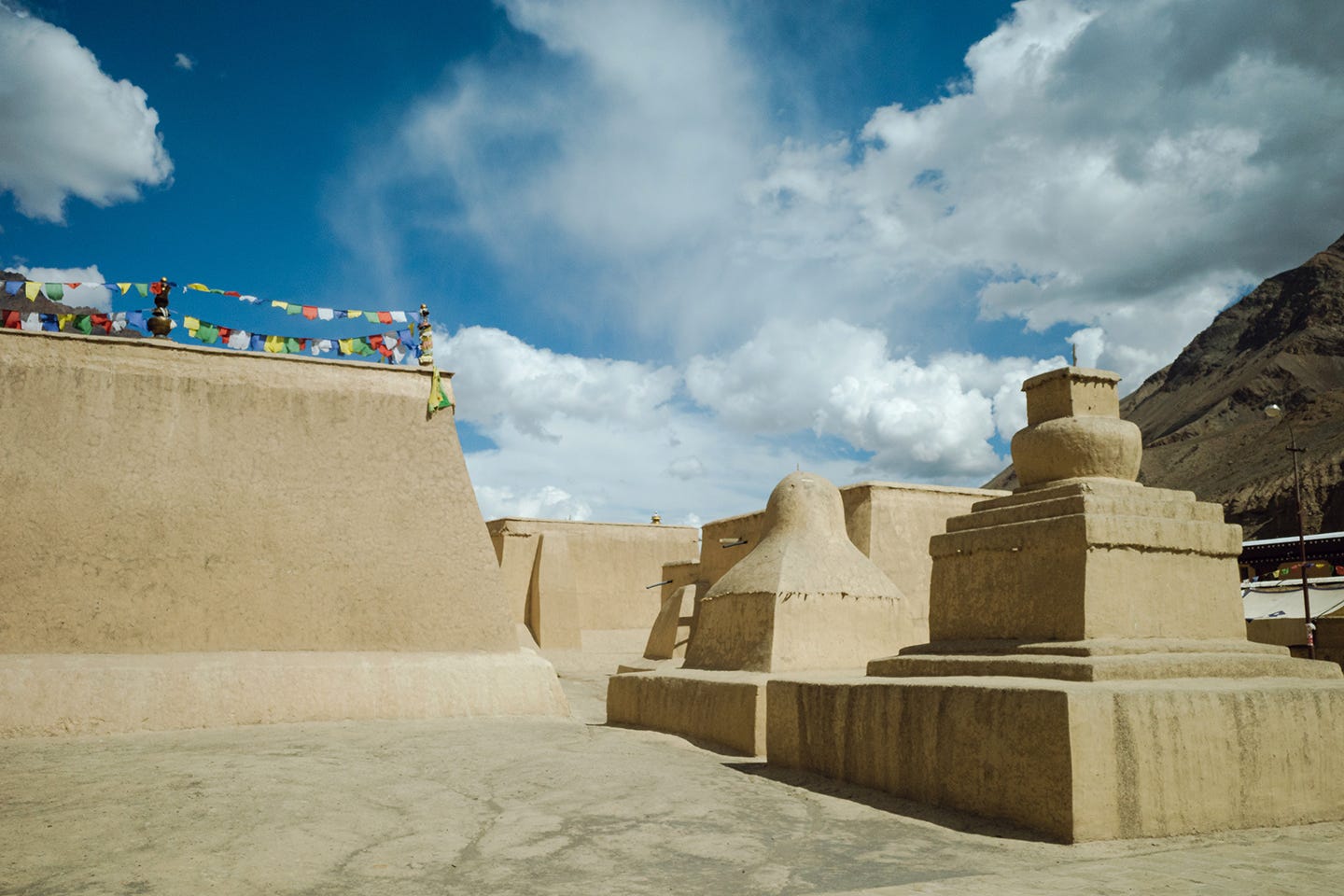
In the middle of one of these fresh oases stands the main reason for my journey by road from Leh: Tabo Monastery, founded in the tenth century under the talented Tibetan translator Rinchen Zangpo, whose legacy also lives on in the extraordinary temples of Alchi in Ladakh. And, by a wonderful coincidence, I also had the chance to meet his nineteenth reincarnation, known as His Eminence Lochen Tulku Rinpoche.
The mud walls of Tabo blend into the brownish hues of the landscape, making the complex of buildings almost disappear into the valley, as if it had grown straight out of the earth, like a seed carrying a very old story to tell. Inside, it shelters an entire celestial Buddhist cosmology: deities, protectors, and the kind of monsters that Buddhism has given a more useful job, protecting us far better than we ever could protect ourselves.
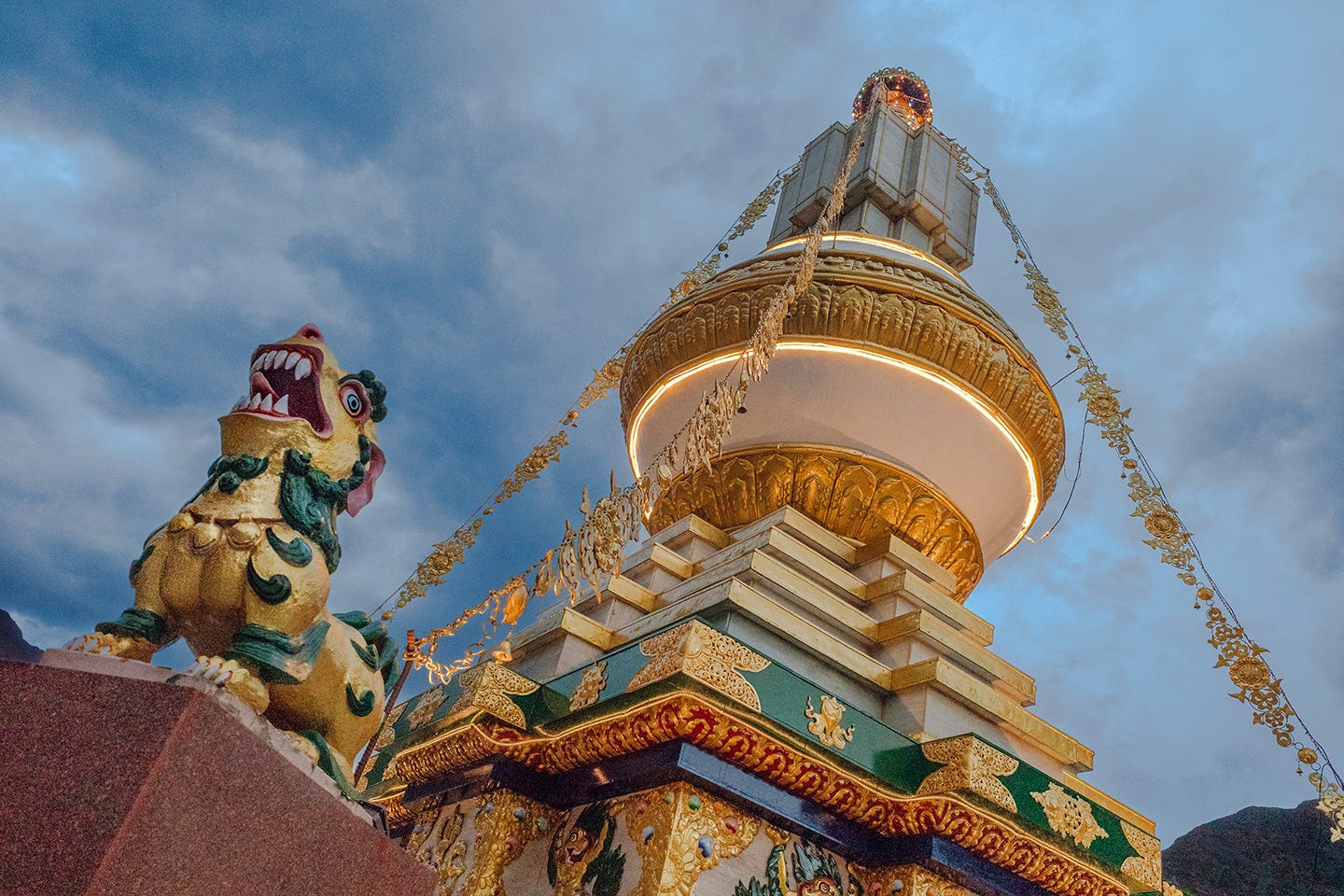
I ended up visiting the monastery twice, both times with a fever that had started four days earlier, while I was in Key. Not in my best body suit, I know. So there I went. Feverish. High on altitude. But ready for whatever came. I let the sacred atmosphere around me play a little with my perception, which may have been a little off.
The group of colourful statues, dressed in their vivid attire, made me feel as if I had somehow been invited to a spiritual feast; the only tiny problem was that I had clearly missed the dress code. I was dishevelled and miserable, and they all seemed to float off the walls like enlightened royalty. Ghostly entities coming alive, not looking straight at me but scrutinising the 360 degrees of my soul. Every single niche, every wooden beam, and every peeling surface became part of this moody ballroom. Like a portal into another time, another plane.
It was not accidental. My delirium had a point. That was the Assembly Hall (’Du khang), one of the many rooms and temples that make up Tabo Monastery, and undoubtedly the one that struck me most. This particular corner was created as a three-dimensional mandala, where its architecture and paintings were organised around the idea that the cosmos outside and the human world within were mirrors of each other. At its centre sits the radiant Vairocana, surrounded by those thirty-two levitating deities. A dream team.
And then I thought about the trees outside.
Very generous with apples.
Both realms in different planes, somehow obeying a similar logic.
Both drawing life towards their centres.
A mandala is not simply a pretty, colourful circle with something “important” in the middle. It is a way of making sense of the whole existence, giving an otherwise bewildering world a midway centre, and a place for everything within it.
A tree does something rather less pretentious, but not entirely different. People gather beneath it, grow food around it, build their homes nearby. It is a never-ending provider of life, with branches reaching upwards and roots growing downwards. Like a direct connection between the ethereal sky above and the tangible earth below.
One puts the vast cosmos in order; the other puts the small pieces of our human world in order. The difference is mostly one of scale:
Just as an apple fits inside a tree. And a tree fits inside a tribal circle. And a tribal circle fits inside the heart of Vairocana. And Vairocana fits the universe inside himself. And the universe fits inside a mandala. And the mandala contains the whole of Buddhist cosmology. But that same infinite universe still hasn’t quite found its way into my decidedly non-enlightened mind¹.
After two days in Tabo, in that tipsy, feverish state, I began to suspect that scale might just be the universe’s way of keeping us confused, with a mandala here, an apple tree there. Somehow, the same old universe, just wearing different clothes.
Funny fact: By the time I left Tabo, it didn’t quite want to finish with me. For a few days, my skin carried a temporary stamp of its own peculiar firmament: the fever had given way to a new, reddish constellation spreading across me (a less celestial and probably uglier one). After nineteen hours on buses in less than twenty-four hours, I reached Chandigarh to find out what the heck was happening in my very earthly body. The rash lingered for another four days, three of them at the city hospital. Thankfully, nothing to worry about :)
¹ I’m currently studying Buddhism online at Tibet House in Delhi. Clearly, I still have some work to do ;)